Stage 1, Stage 2, Stage 3: ECU Tuning Stages Explained
Anyone looking into chiptuning quickly runs into the terms Stage 1, Stage 2 and Stage 3. But what do they actually mean, how much extra power is realistic, and which stage suits your vehicle? This article explains the differences clearly and without marketing promises.
What Does "Stage" Mean in ECU Tuning?
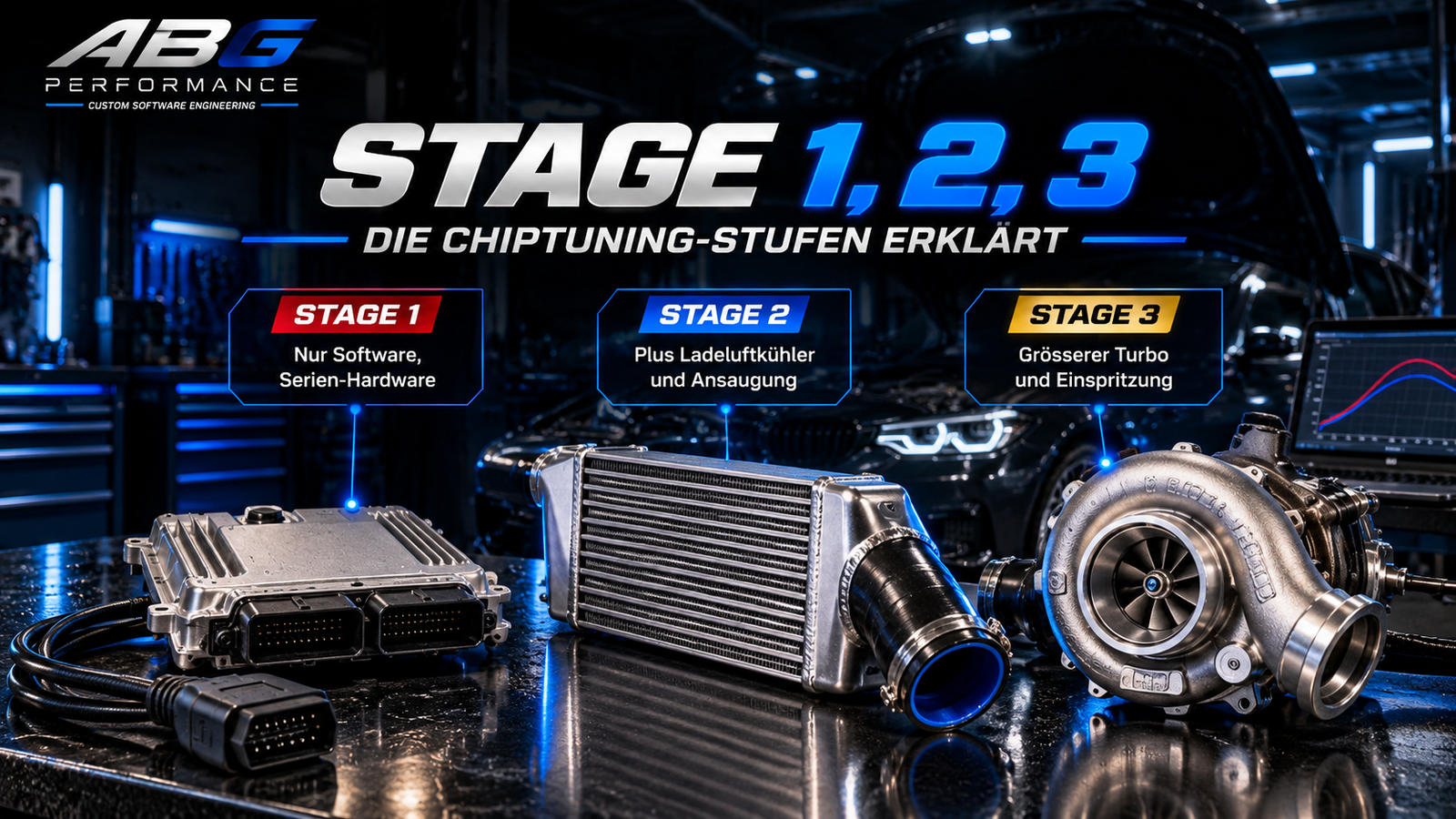
A stage describes how far a vehicle is optimised beyond its factory specification. The higher the stage, the more hardware has to match the software. The terms are not standardised, and every tuner defines them slightly differently. As a rule of thumb:
- Stage 1: software optimisation only, stock hardware
- Stage 2: software plus upgraded hardware such as intake, intercooler or exhaust
- Stage 3: major upgrades, for example a larger turbocharger, injectors or clutch
The stage says nothing about quality. A well-calibrated Stage 1 file is often a better everyday choice than a poorly calibrated Stage 2 project.
Stage 1: More Power with Stock Hardware
Stage 1 only changes the software in the engine control unit (ECU). We read the original file from your ECU, optimise values such as boost pressure, injection quantity, ignition timing and torque limiters, and write the file back. How the ECU is read is explained in our article OBD Tuning vs Chiptuning.
What does Stage 1 deliver?
- On turbocharged engines, often around 10 to 30 percent more power and torque, depending on the model
- Noticeably sharper throttle response and stronger mid-range pull
- On diesel engines, often more relaxed driving at lower rpm
Who is Stage 1 for?
Most everyday drivers. The stock components stay unchanged, the calibration stays within sensible component limits, and the car drives like it did from the factory, only stronger. Naturally aspirated engines gain much less because they lack boost pressure, the most important lever.
At ABG Performance every Stage 1 file is based on your vehicle's original file, not on a generic map. Check whether we support your model in the vehicle catalog.
Stage 2: Software and Hardware Working Together
From Stage 2 onwards, the stock hardware reaches its limits. Typical parts that get upgraded:
- A larger intercooler to keep intake air temperatures stable
- An intake system with less flow restriction
- An exhaust system with lower back pressure
- Depending on the vehicle, a reinforced clutch
The software is then calibrated for exactly this hardware. Running a Stage 2 file on a car without the matching parts is not a good idea.
Important: Emission control systems such as catalytic converters, particulate filters (DPF/OPF) or EGR are not part of a legal Stage 2 build. ABG Performance does not tamper with emission systems. Only use exhaust parts with valid approval.
Stage 3: Major Upgrades for Motorsport and Projects
Stage 3 usually means a larger or different turbocharger, often combined with bigger injectors, a higher-capacity fuel pump, clutch or gearbox upgrades and sometimes internal engine work. This is where the effort is greatest, and calibration requires a lot of experience and repeated power measurements.
Stage 3 is better suited to project cars and motorsport than to the daily commute.
Stage 1, 2 and 3 Compared
| | Stage 1 | Stage 2 | Stage 3 |
|---|---|---|---|
| What changes? | Software only | Software + supporting hardware | Software + turbo, fuelling, drivetrain |
| Power gain (turbo) | often approx. 10–30 % | more than Stage 1, strongly model-dependent | individual |
| Effort | low | medium | high |
| Daily usability | very good | good | limited |
| Registration / inspection | depends on country | usually required | usually required |
These figures are guidelines. What your engine can do depends on the model, ECU, condition and fuel.
Road Legality: Inspection and Insurance
A power increase changes the vehicle technically. Depending on your country, it may need to be registered and inspected, and your insurer should be informed. In Switzerland this involves the MFK inspection. Read more on our page Chiptuning with MFK Questions about warranty are answered under Chip Tuning Warranty.
Which Stage Is Right for You?
- You drive your car every day and want more pull? Stage 1 is almost always the right choice.
- You already have hardware installed or plan upgrades? Then Stage 2, calibrated for exactly those parts, makes sense.
- You are building a project car or doing track days? Then let's talk about Stage 3.
When in doubt: a clean Stage 1 beats a half-hearted Stage 2 project.
Conclusion
Stage 1, 2 and 3 describe how far a vehicle is optimised beyond stock. For most drivers, Stage 1 is the best balance of power, effort and everyday usability. From Stage 2 on, software and hardware must work together properly.
Want to know what is possible for your vehicle? Find your model in the vehicle catalog or contact our team. We give honest advice, even when the answer is "not worth it".