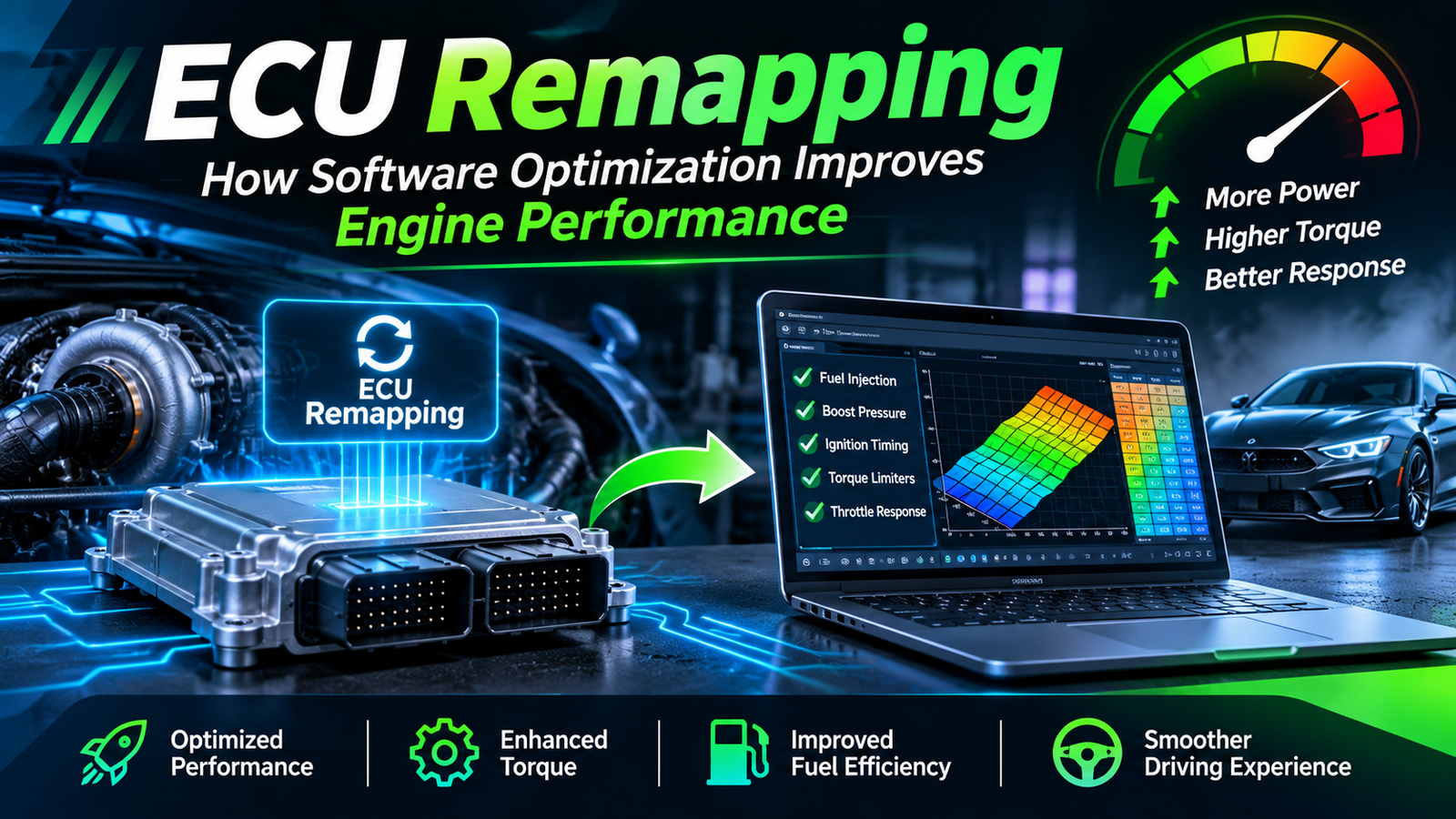
Modern vehicles rely on advanced Engine Control Units (ECUs) to manage engine operation. From fuel injection and ignition timing to turbocharger boost pressure, the ECU continuously processes information from various sensors to maintain efficient and controlled engine performance.
ECU remapping is a process of modifying selected software calibration parameters to change how an engine operates. When performed correctly, it can improve power delivery, increase torque, and create a more responsive driving experience.
What Is ECU Remapping?
ECU remapping, also known as engine remapping or chiptuning, involves modifying the calibration data stored inside a vehicle's Engine Control Unit.
Manufacturers configure ECU software to operate within predefined limits, considering factors such as emissions regulations, fuel quality, environmental conditions, durability, and different market requirements.
Professional tuners can adjust selected calibration maps to achieve specific performance objectives while respecting the limitations of the engine and its supporting components.
The process generally involves reading the original ECU software, modifying relevant parameters, and writing the optimized calibration back to the control unit.
How Does ECU Remapping Work?
ECU remapping involves several important stages.
1. Reading the Original ECU File
The first step is retrieving the original software stored inside the ECU.
Depending on the vehicle and control unit, technicians can use OBD, BENCH, or BOOT programming methods. The original file should be securely backed up before any modifications are made.
2. Analyzing and Modifying Engine Maps
The ECU contains different calibration maps that control engine operation under various conditions.
Professional calibrators may adjust parameters such as:
-
Fuel injection quantity and timing.
-
Turbocharger boost pressure.
-
Ignition timing in petrol engines.
-
Torque limiters.
-
Throttle response.
-
Air-fuel ratio targets.
These parameters work together. Changing one value without considering related engine systems can negatively affect performance and reliability.
3. Writing the Optimized Software
After calibration, the modified file is prepared for programming.
The appropriate programming tool is used to write the optimized software back to the ECU. Checksum validation and other required file checks must be completed for supported applications.
4. Testing and Data Logging
The final stage involves checking how the engine performs with the updated calibration.
Technicians can use diagnostic tools, real-time data logging, and dynamometer testing to evaluate engine behavior and verify whether the expected results have been achieved.
Key ECU Parameters That Affect Engine Performance
Understanding the main engine calibration parameters is essential for professional ECU tuning.
Fuel Injection
Fuel injection determines how much fuel enters the combustion chamber and when it is delivered.
Appropriate adjustments can help maintain the required air-fuel mixture under different engine loads and operating conditions.
Turbocharger Boost Pressure
In turbocharged engines, boost pressure affects the amount of air entering the engine.
Careful calibration can improve torque and power delivery. However, excessive boost can increase thermal and mechanical stress on engine components.
Ignition Timing
Ignition timing determines when the spark plug ignites the air-fuel mixture in petrol engines.
Optimizing ignition timing can improve combustion efficiency and engine response. However, incorrect settings may increase knock risk and potentially damage engine components.
Torque Limiters
Torque limiters help control the maximum torque requested or delivered by the engine.
Proper calibration ensures that torque requests remain compatible with engine protection strategies and other vehicle systems, including the transmission.
Benefits of Professional ECU Remapping
When performed on a suitable vehicle with appropriate calibration, ECU remapping may offer several benefits.
Improved Power Delivery: Optimized engine parameters can increase available power within the limits of the engine and supporting hardware.
Increased Torque: Carefully adjusted calibration maps can improve torque delivery across selected engine speed ranges.
Better Throttle Response: Adjustments to torque requests and throttle-related parameters can create a more responsive driving experience.
Customized Performance: Calibration can be tailored to the vehicle's hardware configuration, intended application, and performance requirements.
Improved Driving Experience: A well-developed calibration can provide smoother and more consistent engine behavior.
Fuel consumption may also change, but improvements are not guaranteed. Actual results depend on the engine, calibration, driving conditions, and driver behavior.
Why Data Logging Is Important in ECU Tuning
ECU tuning should not rely on assumptions or estimated performance figures alone.
Data logging allows technicians to record important engine parameters while a vehicle is operating.
Depending on the ECU and available sensors, useful parameters may include:
-
Boost pressure.
-
Engine load.
-
Torque values.
-
Air-fuel ratio or lambda.
-
Exhaust gas temperature.
-
Intake air temperature.
-
Engine speed.
By analyzing these measurements, calibrators can identify potential issues and evaluate how the engine responds to software changes.
Dynamometer testing can provide additional information about power and torque output under controlled conditions.
Is ECU Remapping Safe for Every Vehicle?
ECU remapping is not automatically suitable for every vehicle.
The condition of the engine, turbocharger, fuel system, cooling system, and transmission should be evaluated before tuning.
An aggressive or poorly developed calibration can increase mechanical stress, raise operating temperatures, and affect long-term reliability.
Professional tuning should also preserve essential engine protection strategies and comply with applicable emissions and road-use regulations.