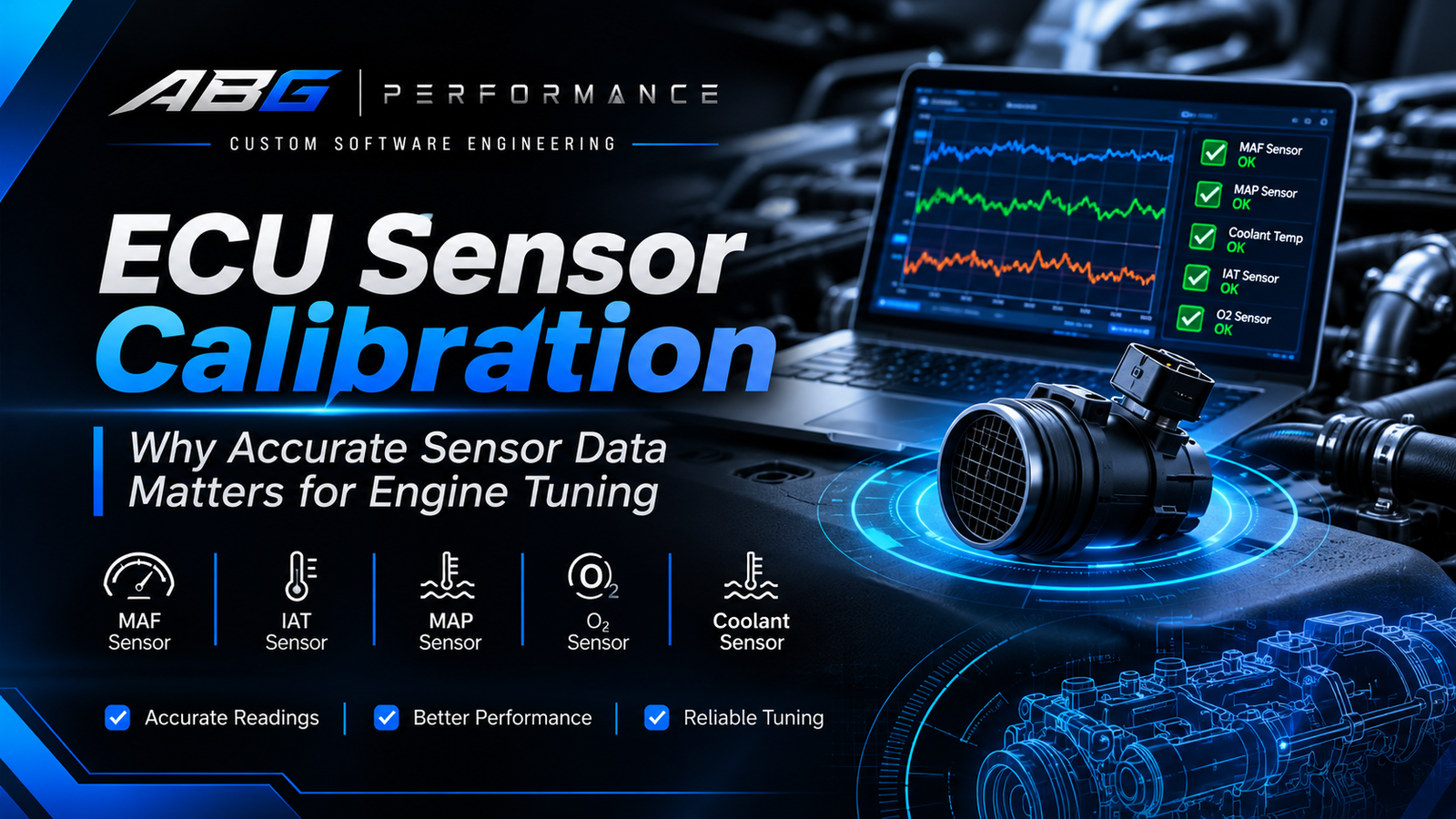
ECU Sensor Calibration: Why Accurate Sensor Data Matters for Engine Tuning
Modern vehicles rely on multiple sensors to monitor engine conditions and maintain optimal performance. These sensors continuously send information to the Engine Control Unit (ECU), allowing it to adjust fuel injection, ignition timing, boost pressure, and other operating parameters.
During ECU tuning, accurate sensor readings are essential. Incorrect or unreliable data can affect tuning decisions and potentially lead to poor engine performance.
What Is ECU Sensor Calibration?
ECU sensor calibration refers to ensuring that sensors provide accurate readings within their specified operating ranges.
Common engine sensors include:
-
Mass Air Flow (MAF) Sensor
-
Manifold Absolute Pressure (MAP) Sensor
-
Intake Air Temperature (IAT) Sensor
-
Coolant Temperature Sensor
-
Oxygen (Lambda) Sensor
-
Crankshaft and Camshaft Position Sensors
Each sensor provides information that helps the ECU manage engine operation.
Why Sensor Accuracy Matters in ECU Tuning
An ECU calibration is only as reliable as the information available to the ECU.
Incorrect sensor readings can cause several issues:
1. Incorrect Fuel Delivery
MAF and MAP sensor readings help determine engine load. Incorrect values can affect fuel injection calculations.
2. Unstable Engine Performance
Faulty temperature or pressure readings may cause unexpected changes in engine management.
3. Incorrect Boost Control
On turbocharged engines, pressure sensor accuracy is important for monitoring actual boost levels and controlling turbocharger operation.
4. Reduced Tuning Reliability
Unreliable sensor data makes it difficult to evaluate engine behaviour and validate calibration changes.
How Are ECU Sensors Checked Before Tuning?
Professional diagnostics generally involve:
-
Reading diagnostic trouble codes (DTCs).
-
Comparing live sensor values with manufacturer specifications.
-
Checking wiring and electrical connections.
-
Inspecting sensor response under different operating conditions.
-
Verifying that measured values are plausible and consistent.
Why Professional Diagnostics Matter
Before modifying ECU software, technicians should establish that the engine and its supporting systems are operating correctly.
Sensor-related faults should be investigated and resolved before performance calibration begins.