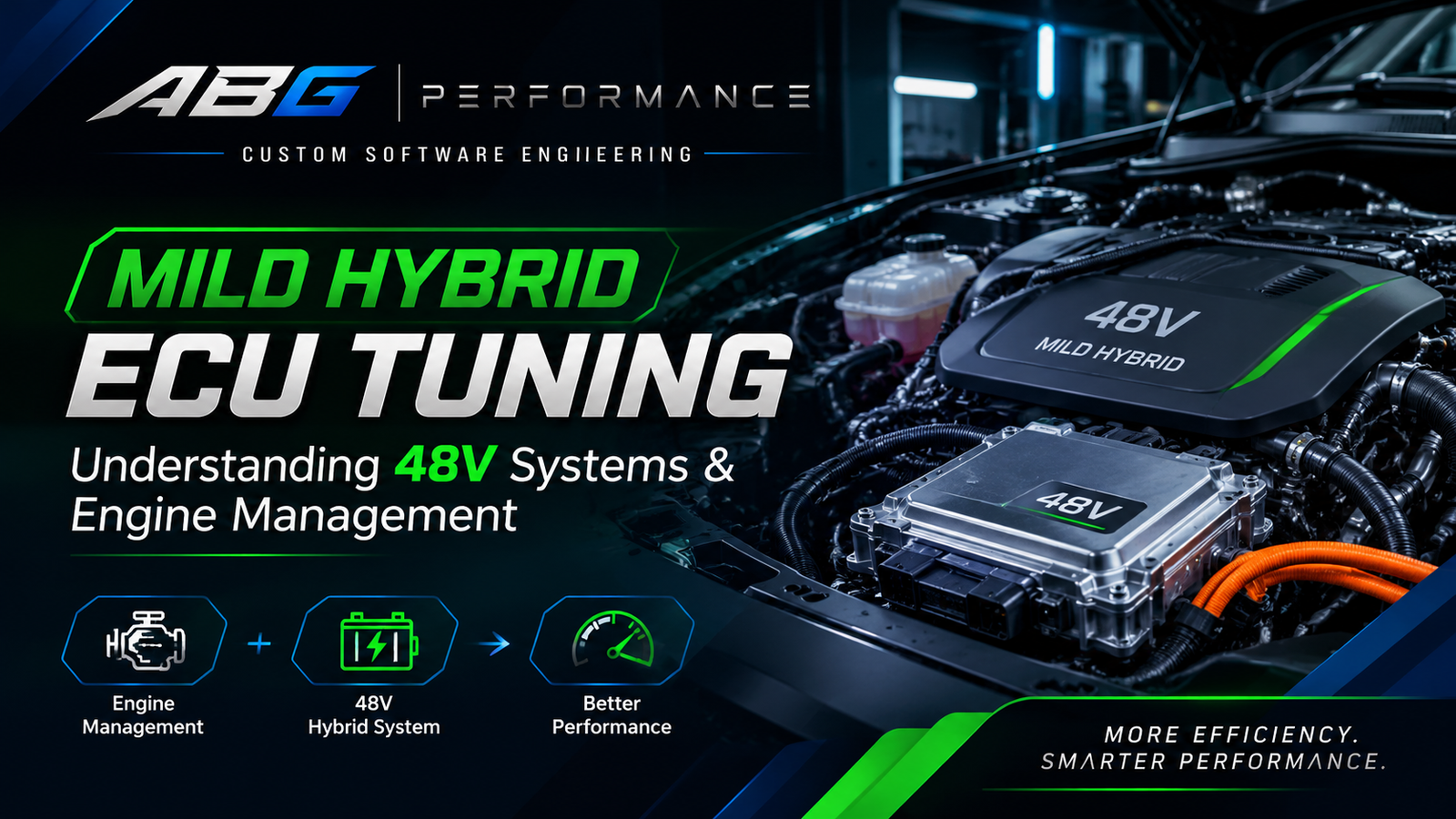
Modern automotive technology is evolving beyond conventional combustion engines. Mild hybrid technology has become increasingly common in modern petrol and diesel vehicles, combining traditional engine systems with electrical assistance to improve efficiency, reduce fuel consumption and enhance overall driving performance.
Unlike full hybrid or fully electric vehicles, mild hybrid vehicles cannot normally drive using electric power alone. Instead, an integrated electrical system supports the combustion engine during selected operating conditions.
This combination introduces additional considerations for engine management, torque coordination and ECU calibration.
Understanding how these systems operate is essential for anyone involved in modern automotive diagnostics and performance optimization.
1. What Is Mild Hybrid Technology?
A Mild Hybrid Electric Vehicle (MHEV) combines a conventional internal combustion engine with an electric assistance system.
Most modern MHEV vehicles use a 48V electrical architecture, although some manufacturers also use 12V mild hybrid configurations.
A typical mild hybrid system includes an electric motor-generator that supports the combustion engine without replacing it.
Depending on the vehicle architecture, the system can provide:
-
Additional torque assistance during acceleration.
-
Energy recovery during deceleration.
-
Improved engine start-stop functionality.
-
Reduced engine load under certain operating conditions.
-
More efficient electrical power management.
One commonly used component is the Belt Starter Generator (BSG), which is connected to the engine through a belt drive and can operate as both a starter and a generator.
2. How Does a 48V Mild Hybrid System Work?
A 48V mild hybrid system provides additional electrical power compared with a conventional 12V vehicle electrical network.
Its main components typically include:
-
48V lithium-ion battery.
-
Belt Starter Generator (BSG) or integrated starter-generator.
-
DC-DC converter.
-
Power electronics.
-
Battery Management System (BMS).
-
Electronic control units and communication networks.
During acceleration, the starter-generator can provide electrical assistance to support the combustion engine, depending on the system design.
During deceleration, the generator can convert part of the vehicle's kinetic energy into electrical energy and store it in the battery.
This process is known as regenerative energy recovery or recuperation.
The recovered energy can subsequently support electrical consumers and assist engine operation under suitable conditions.
The main objective is to improve overall powertrain efficiency without requiring a conventional full-hybrid drivetrain.
3. The Role of ECU and Hybrid Control Systems
Modern mild hybrid vehicles rely on several interconnected electronic control units.
The Engine Control Unit (ECU) manages combustion-related functions, while additional controllers coordinate electrical assistance and battery operation.
Depending on the vehicle architecture, these systems may include:
-
Engine Control Unit (ECU).
-
Hybrid Control Unit (HCU).
-
Battery Management System (BMS).
-
Powertrain Control Module (PCM).
-
Starter-Generator Control Unit.
These controllers exchange information to coordinate engine torque, electrical assistance and energy management.
For example, during acceleration, the engine management system and hybrid control system can coordinate their torque requests to provide smooth and predictable power delivery.
This interaction means that ECU calibration in mild hybrid vehicles requires an understanding of the complete powertrain architecture, rather than focusing exclusively on the combustion engine.
4. How Mild Hybrid Technology Influences Engine Performance
Electric assistance can influence the way a vehicle delivers torque and responds to driver input.
Depending on the powertrain configuration, the starter-generator may support the combustion engine during acceleration and help improve the overall driving experience.
Potential advantages include:
-
Improved acceleration response.
-
Additional torque assistance during certain operating conditions.
-
Smoother engine restart functionality.
-
More efficient energy recovery.
-
Reduced fuel consumption under suitable driving conditions.
However, these benefits depend on several factors, including the electric machine's output, battery charge level, system temperature and manufacturer-specific control strategies.
Mild hybrid technology does not automatically mean a significant increase in maximum engine power. Its primary purpose is generally to improve efficiency and support the conventional powertrain.
5. Key Challenges in Mild Hybrid ECU Tuning
Mild hybrid ECU tuning requires a more comprehensive understanding of engine management and electrical powertrain coordination.
Several important factors must be considered.
Torque Coordination
The combustion engine and electric assistance system must work together within the manufacturer's defined torque limits. Incorrect adjustments can affect acceleration behavior, drivability and system operation.
Thermal Management
Engine temperature, starter-generator temperature and battery operating conditions must remain within their specified limits.
Battery Management
The Battery Management System controls charging, discharging and battery protection. These functions are essential for maintaining battery performance and operational safety.
Communication Between Control Units
Different control units exchange information through vehicle communication networks. Changes to one controller may influence the behavior of other connected systems.
Factory Protection Strategies
Torque monitoring, temperature protection, battery safeguards and diagnostic functions are important parts of modern powertrain management and must be respected during calibration.
6. ECU Compatibility and Programming Methods
Not all mild hybrid vehicles use the same ECU hardware, software architecture or programming protocols.
Depending on the manufacturer, vehicle model and control unit, programming access may be available through OBD, BENCH or BOOT methods.
Before starting a programming operation, technicians should verify:
-
ECU manufacturer and hardware identification.
-
Software version and calibration identification.
-
Available programming protocols.
-
Original software backup and recovery options.
-
Compatibility with the selected tuning equipment.
-
Interaction with other powertrain control modules.
Professional tuning platforms continue to expand their ECU and vehicle coverage. However, support for a particular vehicle or control unit does not necessarily mean that every calibration parameter is available for modification.
Compatibility should always be checked against the exact ECU hardware and software version.
7. Why Safe Calibration and Validation Matter
Performance optimization must never compromise the reliability of a mild hybrid powertrain.
Unlike conventional vehicles, mild hybrid systems introduce additional electrical and thermal considerations that must be evaluated during calibration.
A professional approach should consider:
-
Engine torque and load limitations.
-
Electric assistance strategies.
-
Battery charging and discharging limits.
-
Starter-generator operating conditions.
-
Thermal protection functions.
-
Fuel delivery and combustion efficiency.
-
Emissions compliance.
-
Overall powertrain reliability.
A responsible calibration process should begin with vehicle diagnostics and original software backup, followed by compatibility verification, controlled adjustments and appropriate validation.
Where supported, diagnostic data logging and performance testing can help evaluate the behavior of the modified powertrain.
The objective is not simply to increase engine output, but to maintain predictable operation and protect the complete powertrain system.