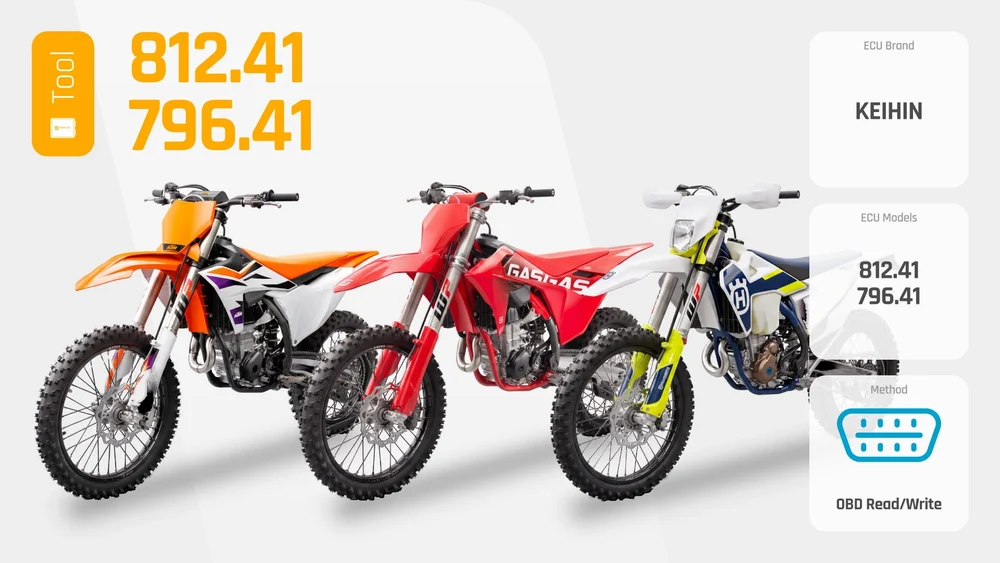
Motorcycle performance is not determined by engine displacement alone. Modern motorcycles rely on sophisticated Engine Control Units (ECUs) to manage fuel injection, ignition timing, throttle response and several other critical engine functions.
With the development of modern engine management systems, ECU tuning has become an important part of motorcycle performance optimization. Through carefully calibrated software adjustments, it is possible to improve engine response, refine power delivery and achieve a more consistent riding experience.
But how does motorcycle ECU tuning actually work, and which parameters make the biggest difference?
1. What Is Motorcycle ECU Tuning?
Motorcycle ECU tuning involves modifying the engine management software to optimize how the engine operates under different conditions.
The ECU continuously processes information from various sensors and controls essential engine parameters. Depending on the motorcycle and ECU architecture, these include:
-
Fuel injection quantity and timing
-
Ignition timing
-
Throttle response
-
Air-fuel ratio
-
Engine temperature protection
-
Torque and load management
-
RPM and throttle limitations
Professional ECU calibration focuses on adjusting relevant parameters to achieve the desired performance characteristics without compromising engine protection or reliability.
2. How ECU Tuning Improves Throttle Response
Throttle response describes how quickly an engine reacts when the rider opens the throttle.
Some motorcycles feature factory throttle maps designed to prioritize emissions compliance, smooth operation and predictable power delivery. Although these settings are suitable for everyday riding, they may not always provide the most responsive experience.
Through optimized throttle mapping and appropriate engine calibration, technicians can refine how the engine responds to throttle input.
Potential improvements include:
-
More consistent throttle response
-
Smoother acceleration
-
Improved low- and mid-range power delivery
-
Better control during acceleration
The actual results depend on the motorcycle model, engine configuration and factory calibration.
3. Fuel Injection and Air-Fuel Ratio Optimization
Fuel delivery is one of the most important aspects of motorcycle ECU calibration.
Modern fuel-injected motorcycles use sensor data to determine how much fuel is required under different operating conditions. The ECU adjusts injection parameters according to engine load, RPM, intake air temperature and other relevant inputs.
During professional tuning, the air-fuel ratio (AFR) is an important consideration.
A properly calibrated fuel strategy can help:
-
Maintain appropriate combustion conditions.
-
Improve power delivery under different loads.
-
Reduce unnecessary fuel enrichment.
-
Support consistent engine operation.
However, fuel adjustments must remain within the engine's safe operating requirements. Incorrect calibration can increase combustion temperatures, reduce efficiency or cause engine damage.
4. Ignition Timing and Engine Performance
Ignition timing determines when the spark plug ignites the air-fuel mixture inside a petrol engine's combustion chamber.
It directly influences combustion efficiency, torque production and engine response.
Adjusting ignition timing can help optimize performance across different RPM ranges. However, advancing ignition timing too aggressively can increase the risk of engine knock.
Professional calibration considers factors such as:
-
Engine load and RPM
-
Fuel quality and octane rating
-
Intake air temperature
-
Combustion stability
-
Knock protection strategies
The objective is to achieve efficient combustion while maintaining appropriate safety margins.
5. The Importance of ECU Compatibility and Programming Methods
Not every motorcycle ECU can be accessed or programmed using the same method.
Depending on the ECU hardware, software and available protocol, programming may require OBD, BENCH or BOOT access.
The correct approach depends on several factors:
-
ECU manufacturer and hardware generation
-
Available communication protocols
-
Vehicle model and production year
-
Read and write capabilities
-
Security and unlocking requirements
Recent developments in professional tuning equipment demonstrate the growing coverage of motorcycle and powersports ECUs, including different programming solutions for Bosch and Keihin-based systems.
Before attempting any programming operation, technicians should verify ECU compatibility and follow the manufacturer's recommended procedures.
6. Why Testing and Validation Matter
A successful ECU calibration involves more than modifying software parameters.
Testing and validation are essential to confirm that the revised calibration performs as expected under real operating conditions.
A professional workflow may include:
-
Reading and backing up the original ECU data.
-
Checking the motorcycle's mechanical condition.
-
Reviewing relevant sensor readings and diagnostic information.
-
Making controlled calibration adjustments.
-
Writing the modified software using a compatible programming method.
-
Testing engine behavior under appropriate operating conditions.
-
Comparing results and verifying that no new faults have appeared.
Where appropriate, dyno testing and controlled data logging can provide additional information about engine performance and calibration quality.
7. Performance vs. Reliability: Finding the Right Balance
Increasing engine output should never be the only objective of motorcycle ECU tuning.
Every engine has operating limits influenced by its mechanical design, cooling system, fuel quality and component condition.
Excessive adjustments can increase thermal stress, combustion pressure and mechanical wear.
A responsible tuning strategy prioritizes:
-
Safe ignition timing
-
Appropriate fuel delivery
-
Controlled engine temperatures
-
Consistent torque delivery
-
Proper engine protection strategies
The best calibration is not necessarily the one that produces the highest peak power. It is the one that delivers suitable performance while respecting the engine's operating limits.