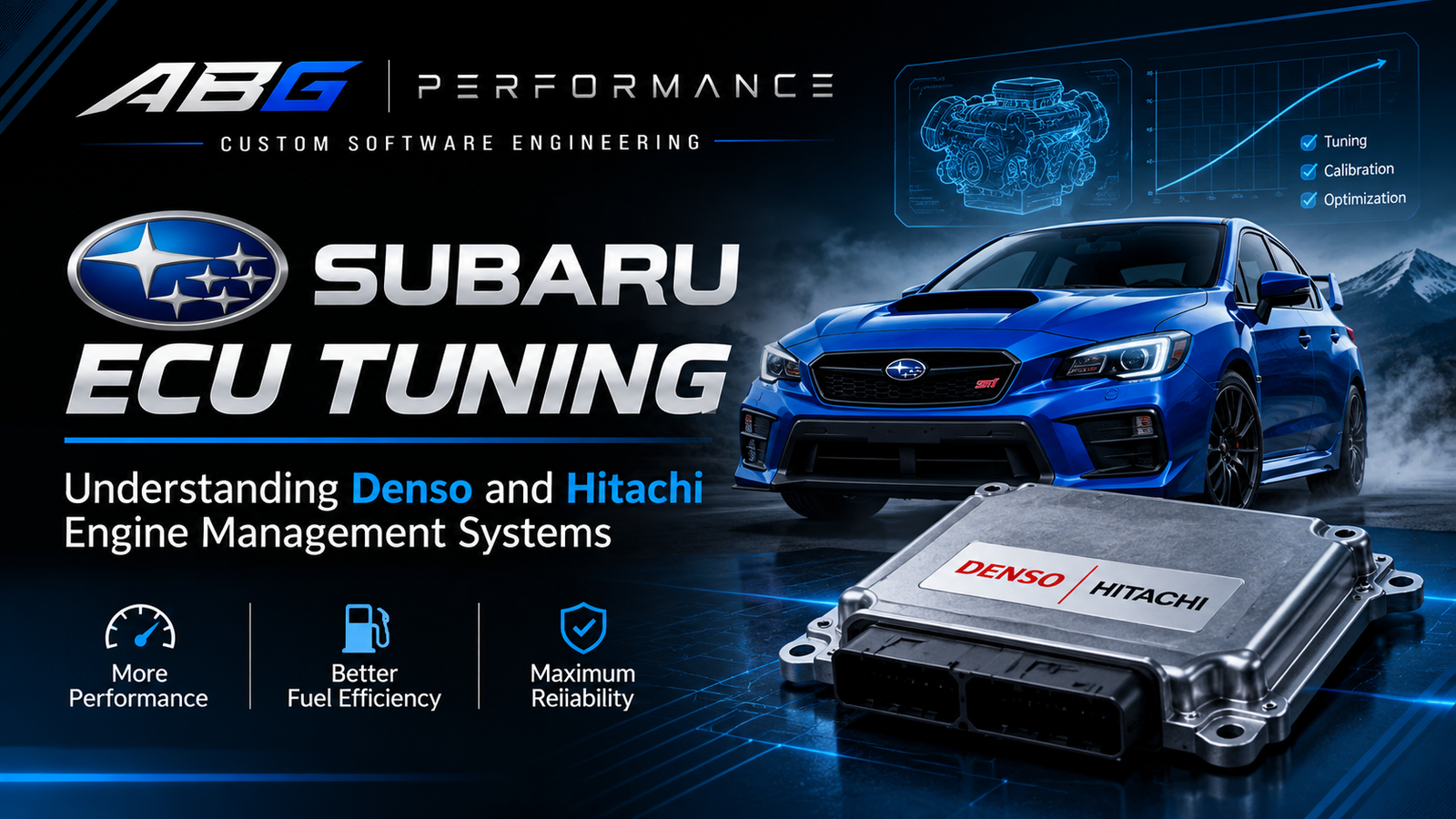
Subaru vehicles are well known for their distinctive Boxer engines, symmetrical all-wheel-drive systems, and performance-oriented engineering. From everyday SUVs to high-performance WRX models, Subaru uses sophisticated engine management systems to balance power delivery, fuel efficiency, emissions, and engine protection.
At the heart of these systems is the Engine Control Unit (ECU), which continuously processes information from various sensors and controls critical engine parameters.
Depending on the vehicle model, engine configuration, and production year, Subaru vehicles may use engine management systems from manufacturers such as Denso and Hitachi.
Understanding these ECU platforms is essential for professional chiptuning, accurate calibration, and reliable performance optimization.
1. Understanding Denso and Hitachi ECUs in Subaru Vehicles
Denso and Hitachi are established automotive electronics manufacturers that supply engine management technology for different vehicle applications.
Subaru has used ECU platforms from both manufacturers across various generations of vehicles.
Denso ECUs
Denso engine management systems are found in several Subaru petrol and diesel applications. They manage important engine functions, including fuel injection, ignition control, boost regulation, and sensor-based engine protection.
Hitachi ECUs
Hitachi ECU platforms are also used in various Subaru models. Depending on the architecture, these systems process engine operating data and control fuel delivery, ignition parameters, and other engine functions.
The exact ECU manufacturer and hardware architecture depend on the specific vehicle and engine configuration.
2. How ECU Tuning Improves Subaru Engine Performance
Professional ECU tuning involves modifying selected calibration parameters within the engine control software to improve engine characteristics.
The objective is not simply to increase power. A properly developed calibration should maintain a balance between performance, drivability, and mechanical reliability.
Key calibration areas include:
Fuel Injection Optimization
Fuel injection parameters determine how much fuel enters the combustion chamber and when injection occurs. Accurate calibration helps maintain an appropriate air-fuel mixture under different operating conditions.
Ignition Timing Adjustment
Ignition timing influences combustion efficiency, torque production, and engine temperature. Adjustments must consider fuel quality, engine load, and knock limitations.
Turbocharger Boost Management
Turbocharged Subaru engines rely on precise boost control. ECU calibration can optimize boost targets and control strategies while respecting turbocharger and engine limitations.
Torque Management
Modern engine management systems use torque models and limitations to control power delivery. Appropriate calibration helps maintain predictable acceleration and smooth vehicle operation.
3. OBD ECU Programming: A More Accessible Tuning Method
OBD programming allows compatible ECUs to be read and written through the vehicle's diagnostic connector.
For supported Subaru ECU platforms, this method can simplify the tuning workflow because the ECU does not necessarily need to be removed from the vehicle.
However, OBD compatibility depends on the ECU hardware, software version, vehicle configuration, and available programming protocols.
Not every Subaru ECU supports direct OBD programming. Some applications may require alternative access methods or additional unlocking procedures.
4. Why Accurate ECU Calibration Matters
Subaru engines require carefully controlled operating parameters, particularly in turbocharged applications.
An unsuitable calibration can increase mechanical stress, raise exhaust gas temperatures, or create combustion-related problems.
Professional calibration should consider several factors:
- Engine condition and mechanical health
- Fuel quality and octane rating
- Turbocharger operating limits
- Air-fuel ratio and ignition timing
- Intake air and coolant temperatures
- Knock control and engine protection strategies
- Exhaust gas temperature and emissions requirements
Vehicle-specific data logging and appropriate testing help verify whether the calibration performs as intended.
5. Which Subaru Models Can Benefit from ECU Optimization?
Different Subaru models use different engine management systems, depending on their generation and specifications.
Examples include:
- Subaru WRX: Turbocharged Boxer petrol engines designed for performance applications.
- Subaru WRX STI: Performance-focused models with specialized engine and boost management strategies.
- Subaru Forester: Petrol and turbocharged variants with different engine management configurations.
- Subaru Outback: Multiple engine configurations designed for everyday driving and long-distance performance.
- Subaru Legacy: Various petrol and turbocharged powertrains across different generations.
ECU tuning availability must always be verified against the exact ECU hardware and software identification. Model names alone are not sufficient to establish compatibility.
6. The Importance of Professional Testing After ECU Tuning
ECU calibration should never be considered complete simply because modified software has been successfully written to the vehicle.
Post-tuning verification is essential for evaluating engine behaviour under different operating conditions.
A professional testing process may include:
1. Reading and saving the original ECU data.
2. Checking diagnostic trouble codes before calibration.
3. Reviewing relevant engine parameters through data logging.
4. Developing a vehicle-specific calibration.
5. Writing the modified software using a compatible programming method.
6. Checking actual boost, fuel delivery, ignition behaviour, and engine temperatures.
7. Performing controlled road or dynamometer testing where appropriate.
This process helps identify potential issues and ensures that the calibration is consistent with the vehicle's mechanical condition.