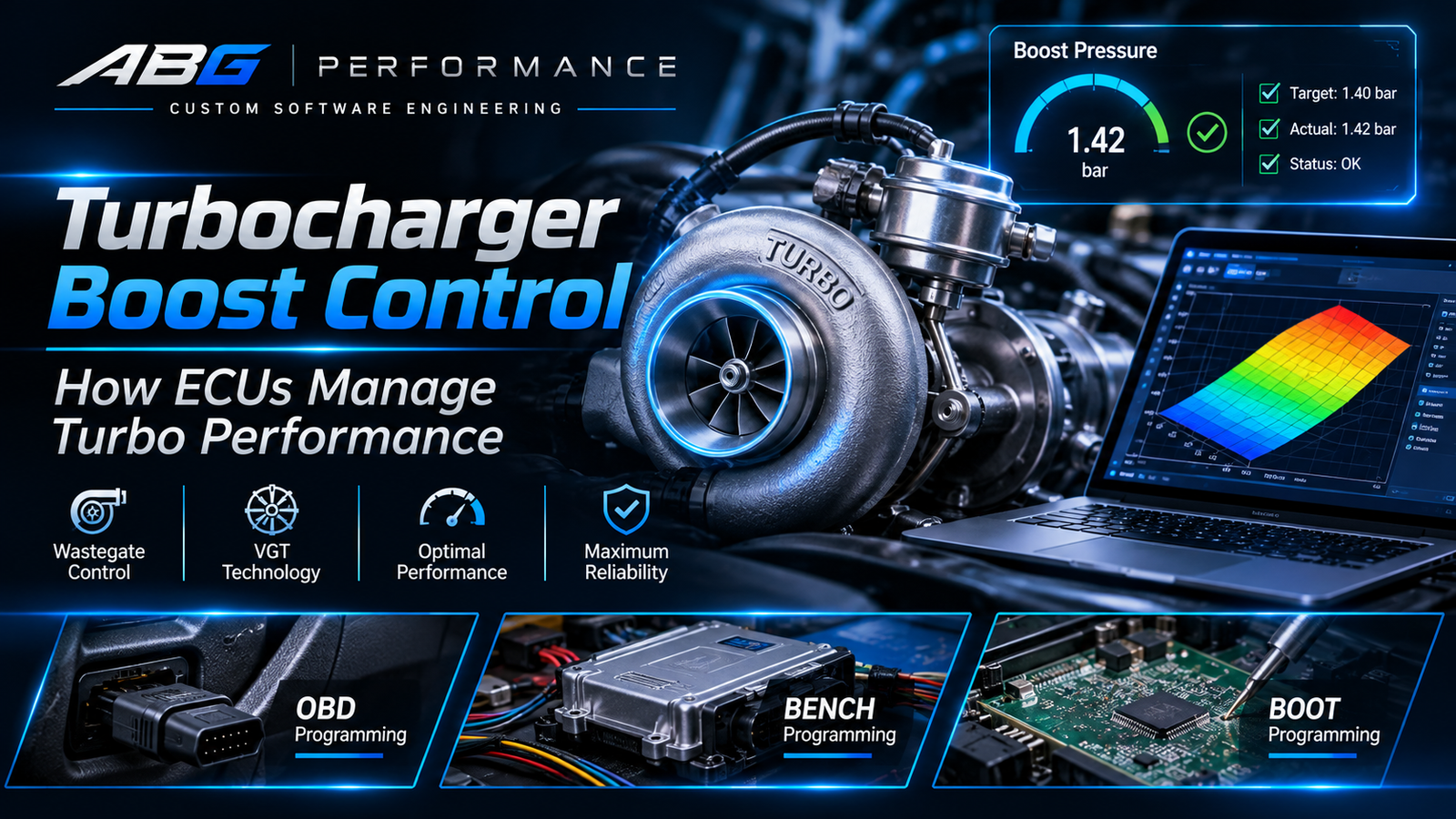
Turbochargers play an important role in modern engine performance. By using exhaust gas energy to compress incoming air, a turbocharger allows an engine to produce more power without requiring a significant increase in engine displacement.
However, generating boost pressure is only part of the process. Controlling that pressure accurately is essential for maintaining engine performance, efficiency, and reliability.
Modern Engine Control Units (ECUs) continuously monitor and adjust turbocharger operation according to engine load, RPM, temperature, and driving conditions.
Understanding how boost control works is an important part of professional ECU calibration and performance tuning.
1. How Does Turbocharger Boost Control Work?
A turbocharger consists primarily of two connected sections: a turbine and a compressor.
-
Turbine: Uses exhaust gas energy to rotate the turbocharger shaft.
-
Compressor: Draws in and compresses fresh air before delivering it to the engine.
As the turbocharger spins faster, it can deliver more compressed air into the intake system.
The ECU manages the desired boost pressure by controlling the turbocharger's actuator system. This helps ensure that the engine receives the appropriate amount of air under different operating conditions.
2. Understanding Wastegate Boost Control
A wastegate is a mechanical valve used to regulate exhaust gas flow through the turbocharger turbine.
When boost pressure approaches the desired limit, the wastegate can open and allow some exhaust gas to bypass the turbine.
This reduces the energy driving the turbocharger and helps control boost pressure.
Modern turbocharged engines may use electronically controlled wastegate actuators, allowing the ECU to adjust boost control more precisely.
Why is it important?
-
Helps regulate maximum boost pressure.
-
Supports consistent turbocharger operation.
-
Reduces the risk of excessive boost.
-
Helps maintain the requested engine performance.
3. What Is Variable Geometry Turbocharging (VGT)?
Variable Geometry Turbochargers (VGT), also known as Variable Nozzle Turbines (VNT), use adjustable vanes inside the turbine housing to control exhaust gas flow.
Unlike a conventional fixed-geometry turbocharger, a VGT system can change the effective flow characteristics of the turbine.
At lower engine speeds, the vanes can adjust to improve turbocharger response. At higher engine speeds, their position changes to accommodate increased exhaust flow.
Main Benefits:
-
Improved low-RPM turbocharger response.
-
Better boost control across different engine speeds.
-
Improved driving flexibility.
-
More efficient use of exhaust gas energy.
VGT technology is particularly common in modern diesel engines.
4. How Does the ECU Control Boost Pressure?
The ECU uses multiple sensors and control strategies to maintain the requested boost pressure.
Important parameters include:
Target Boost Pressure: The pressure level requested by the ECU according to operating conditions.
Actual Boost Pressure: The pressure measured by the relevant sensor in the intake system.
Wastegate Position or Duty: Indicates how the actuator is being controlled, depending on the turbocharger system.
Engine RPM: Helps the ECU determine the appropriate turbocharger operating conditions.
Intake Air Temperature: Influences air density and engine operating limits.
Engine Load: Helps determine the required airflow and boost pressure.
By comparing requested and measured boost pressure, the ECU can adjust actuator commands to maintain the desired operating range.
5. What Happens When Boost Pressure Is Incorrect?
Incorrect boost control can negatively affect engine performance and reliability.
Some common symptoms include:
-
Underboost: Actual boost pressure remains below the requested level.
-
Overboost: Actual boost pressure exceeds the permitted target.
-
Reduced acceleration and engine power.
-
Limp mode activation.
-
Turbocharger-related diagnostic trouble codes.
-
Unstable boost pressure during acceleration.
These problems can originate from a faulty actuator, vacuum leak, damaged hoses, boost sensor issues, or mechanical turbocharger problems.
Proper diagnosis is necessary before making any ECU calibration changes.
6. Boost Pressure Monitoring During ECU Tuning
During professional ECU tuning, monitoring boost pressure is essential for understanding how the turbocharger responds to calibration changes.
Technicians commonly compare:
-
Requested boost pressure.
-
Actual boost pressure.
-
Wastegate control values.
-
Engine RPM and load.
-
Intake air temperature.
-
Exhaust gas temperature, where available.
Data logging allows specialists to examine how these parameters behave under different operating conditions.
AutoTuner's datalogging documentation includes boost pressure, boost pressure setpoint, and wastegate duty among its monitoring parameters. Alientech also provides measured and target turbo pressure monitoring through its DataLogger system.
7. Why Professional Boost Calibration Matters
Increasing boost pressure does not automatically mean achieving better engine performance.
A professional calibration must consider the turbocharger's operating limits, airflow requirements, exhaust temperatures, fuel delivery, and engine protection strategies.
Excessive boost can increase thermal and mechanical stress, potentially reducing component reliability.
At ABG Performance, we focus on professional ECU calibration that balances turbocharger performance, engine protection, and long-term reliability.