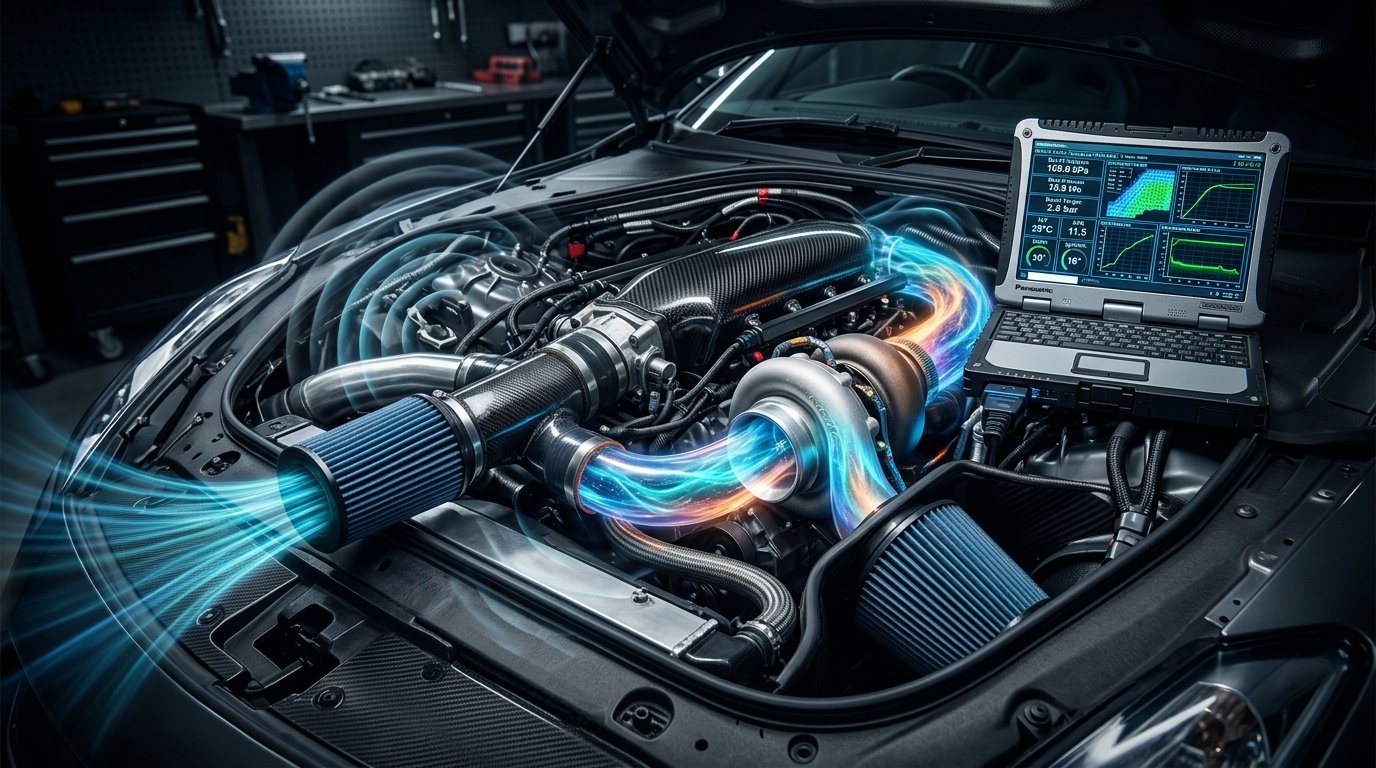
Engine performance depends on more than fuel quality, ignition timing, and turbocharger pressure. Atmospheric conditions also play an important role in how an engine operates. One particularly important factor is barometric pressure, which directly influences the amount of oxygen available for combustion.
Modern engine management systems use pressure sensors and advanced control strategies to adapt engine operation to changing environmental conditions. Whether a vehicle is driving at sea level or travelling through mountainous regions, the ECU must account for changes in atmospheric pressure to maintain efficient and reliable performance.
Understanding this relationship is essential for professional ECU tuning and engine calibration.
What Is Barometric Pressure?
Barometric pressure, also known as atmospheric pressure, is the pressure exerted by the surrounding air. It changes depending on altitude and weather conditions.
At sea level, standard atmospheric pressure is approximately 101.3 kPa (1.013 bar). As altitude increases, atmospheric pressure decreases because there is less air above the vehicle.
This change affects air density and the amount of oxygen entering the engine.
For naturally aspirated engines, lower atmospheric pressure generally means less oxygen is available for combustion. Turbocharged engines can compensate for some of this pressure difference, but their operation still depends on atmospheric conditions and turbocharger limitations.
How Atmospheric Pressure Affects Engine Performance
Air density is a critical factor in combustion. Engines require an appropriate amount of oxygen to burn fuel efficiently and produce power.
When atmospheric pressure decreases, the available oxygen mass in a given volume of air also decreases, assuming other conditions remain comparable.
This can lead to several changes:
-
Reduced power output in naturally aspirated engines.
-
Different air-mass and fuel-delivery requirements.
-
Changes in turbocharger operating conditions.
-
Increased importance of accurate boost-pressure control.
-
Adjustments to engine load and torque calculations.
The ECU uses information from various sensors to adapt fuel delivery and other operating parameters to the current conditions.
The Role of the Barometric Pressure Sensor
The barometric pressure sensor provides the ECU with information about surrounding atmospheric pressure.
Depending on the vehicle's engine management system, this sensor may be integrated into the ECU or installed separately in the engine compartment.
Its measurement helps the ECU determine how environmental pressure affects engine operation.
Barometric pressure information can be used for:
-
Adjusting boost-pressure control targets.
-
Supporting accurate engine-load calculations.
-
Optimizing fuel-delivery strategies.
-
Adapting exhaust gas recirculation (EGR) control.
-
Supporting altitude-dependent engine protection strategies.
A faulty or inaccurate pressure signal can affect engine management calculations and may contribute to drivability issues or diagnostic trouble codes.
Barometric Pressure and Turbocharger Boost Control
Turbocharged engines use compressed intake air to increase the amount of oxygen entering the combustion chambers.
However, turbocharger operation is closely related to atmospheric pressure.
At higher altitudes, lower atmospheric pressure means the turbocharger may need to operate differently to achieve a similar intake manifold pressure.
The ECU monitors available pressure information and adjusts boost-control strategies according to the engine's calibration and operating limits.
This is particularly important because excessive turbocharger speed or temperature can increase mechanical stress and reduce component reliability.
Professional ECU calibration must therefore consider:
-
Atmospheric pressure.
-
Requested and actual boost pressure.
-
Turbocharger operating limits.
-
Intake air temperature.
-
Engine speed and calculated load.
Simply increasing boost pressure without considering these factors can compromise engine reliability.
MAP Sensor vs Barometric Pressure Sensor
Although both sensors measure pressure, they provide different information to the engine management system.
MAP Sensor (Manifold Absolute Pressure)
The MAP sensor measures absolute pressure inside the intake manifold. The ECU uses this information to calculate engine load and, in turbocharged applications, monitor intake pressure.
Barometric Pressure Sensor (BARO)
The barometric pressure sensor measures the surrounding atmospheric pressure. This information helps the ECU compensate for changes in environmental conditions, including altitude.
Using these measurements together allows the ECU to understand the relationship between atmospheric pressure and intake manifold pressure.
Not every vehicle uses separate MAP and BARO sensors. Some engine management systems calculate or estimate barometric pressure using other available sensor data.
Why Barometric Pressure Matters in ECU Remapping
During ECU remapping, engine calibration parameters are adjusted to optimize performance within the vehicle's mechanical and operational limits.
Atmospheric pressure is an important consideration, especially for vehicles equipped with turbochargers.
A properly developed calibration should account for changing environmental conditions rather than focusing only on maximum power under ideal testing conditions.
Professional ECU tuning considers how the engine responds to different pressure levels, temperatures, and load conditions.
Important calibration areas include:
-
Boost Pressure Management: Ensuring requested boost remains within the turbocharger's operating limits.
-
Fuel Delivery: Maintaining appropriate fuel delivery according to available air mass.
-
Engine Protection: Preserving safety strategies under demanding operating conditions.
-
Torque Management: Maintaining predictable torque delivery across different operating conditions.
-
Sensor Accuracy: Ensuring pressure measurements are reliable and correctly interpreted.
These considerations help create a balanced calibration that prioritizes performance, consistency, and engine reliability.
Common Symptoms of Barometric Pressure Sensor Problems
A malfunctioning barometric pressure sensor or incorrect pressure reading can affect engine management.
Depending on the vehicle and ECU strategy, possible symptoms include:
-
Reduced engine performance.
-
Incorrect boost-pressure regulation.
-
Unexpected warning lights.
-
Unusual engine response.
-
Stored diagnostic trouble codes.
-
Inconsistent performance at different altitudes.
However, these symptoms can also be caused by other faults, including MAP sensor issues, boost leaks, wiring problems, or turbocharger control faults.
A proper diagnostic procedure is necessary before replacing components or modifying the ECU calibration.