What Is Turbocharger Boost Pressure?
A turbocharger increases the amount of air entering an engine by using exhaust gas energy to drive a compressor.
By supplying more compressed air, the engine can burn fuel more effectively and produce additional power when the complete engine management system is calibrated accordingly.
Boost pressure is an important measurement in turbocharged petrol and diesel engines. Understanding how the system manages pressure is essential when diagnosing performance issues or evaluating engine operation.
What Is Target Boost Pressure?
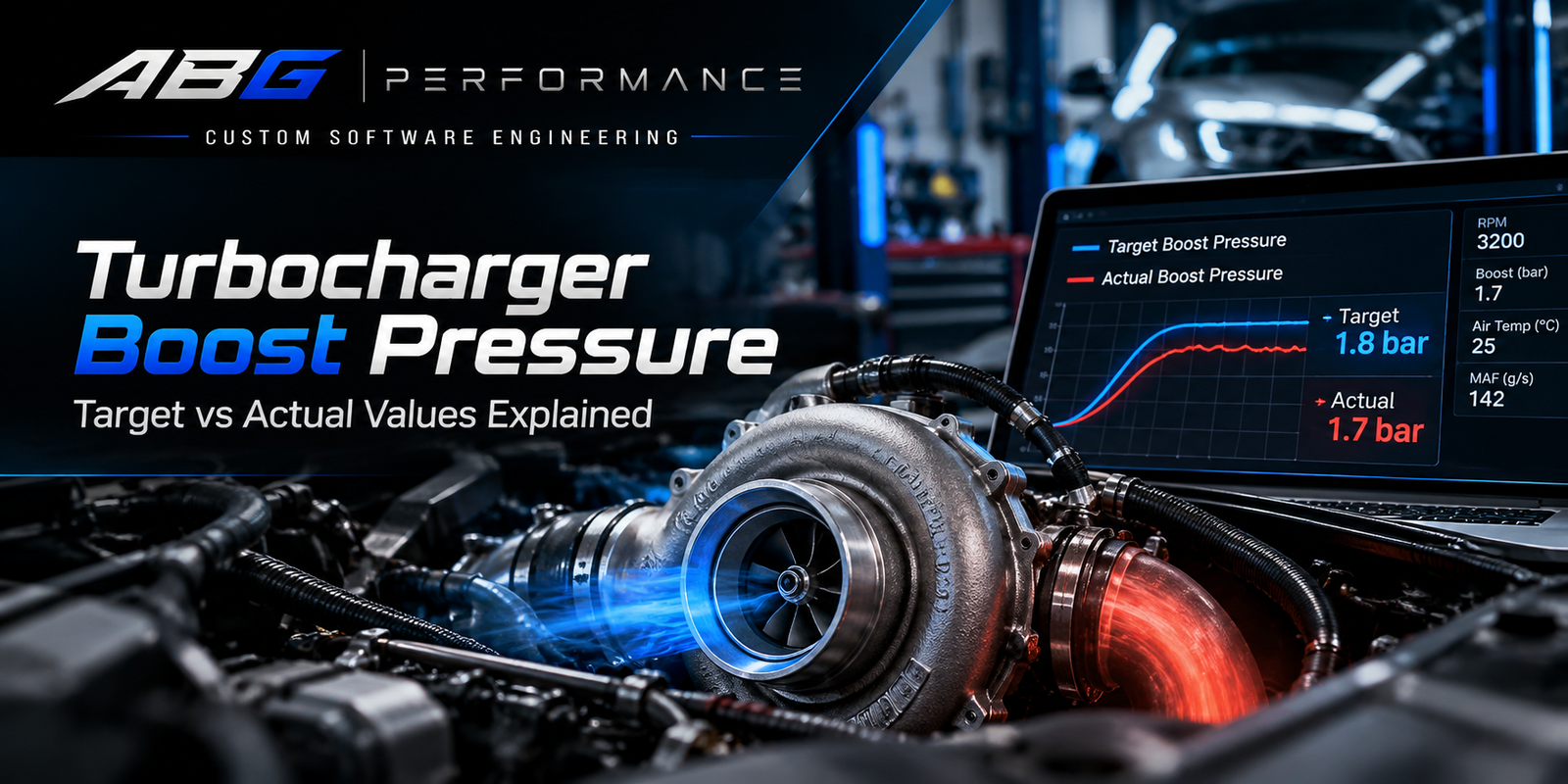
Target boost pressure is the pressure level requested by the engine management system under specific operating conditions.
The ECU calculates this target using several factors, including:
-
Engine speed (RPM)
-
Accelerator pedal position
-
Requested engine torque
-
Engine load
-
Intake air temperature
-
Ambient pressure
-
Engine protection requirements
The target can change continuously depending on driving conditions.
For example, the requested boost pressure during light acceleration may be considerably different from the target under full engine load.
What Is Actual Boost Pressure?
Actual boost pressure is the pressure measured by the vehicle's sensor in the intake or charge-air system.
The ECU compares the measured value with the requested target to determine whether the turbocharger is operating as expected.
When the actual pressure follows the target within the expected control range, the boost regulation system is generally operating correctly.
However, a noticeable difference between the two values may indicate a mechanical, electronic, or control-related issue.
Target vs Actual Boost: Common Differences
Understanding the relationship between requested and measured pressure can help technicians identify potential problems.
1. Underboost
Underboost occurs when actual boost pressure remains below the requested target.
Possible causes include:
-
Leaking charge-air hoses or intercooler connections
-
Turbocharger wear or mechanical damage
-
Faulty boost control solenoids
-
Vacuum system leaks in vacuum-operated systems
-
Problems with variable geometry turbocharger mechanisms
-
Incorrect sensor readings
A vehicle experiencing underboost may show reduced acceleration, limited engine performance, or an engine warning light.
2. Overboost
Overboost occurs when actual boost pressure exceeds the requested target beyond the system's permitted control range.
Potential causes include:
-
Sticking turbocharger actuator mechanisms
-
Incorrect wastegate operation
-
Variable geometry turbocharger control problems
-
Faulty pressure sensors
-
Control system or calibration issues
Depending on the vehicle, the ECU may activate protective strategies to prevent excessive engine stress.
3. Unstable Boost Pressure
Sometimes actual boost pressure fluctuates instead of following the requested value smoothly.
This can be associated with boost leaks, actuator control problems, sensor irregularities, or incorrect pressure regulation.
Accurate diagnosis is necessary before replacing components or changing ECU calibration.
Why Live Data Is Important During Diagnostics
Reading fault codes alone does not always reveal the exact cause of a turbocharger problem.
Professional diagnostic equipment can provide additional information through live engine data.
Important parameters may include:
-
Requested boost pressure
-
Actual boost pressure
-
Turbocharger actuator position
-
Air mass flow
-
Intake air temperature
-
Engine RPM
-
Atmospheric pressure
Comparing these values under appropriate operating conditions helps technicians understand how the turbocharger system responds to changing engine loads.
Pressure readings must also be interpreted correctly. Some vehicles report absolute pressure, while others may display relative boost pressure. These values should not be compared without accounting for atmospheric pressure.
Why Boost Pressure Matters During ECU Tuning
Boost pressure is one of several important parameters considered during turbocharged engine calibration.
However, increasing boost pressure alone does not automatically produce a reliable performance improvement.
A professional calibration must consider other factors, including:
-
Fuel delivery capacity
-
Exhaust gas temperature
-
Turbocharger operating limits
-
Intake air temperature
-
Engine load
-
Component protection strategies
The objective is to achieve an appropriate balance between airflow, fuel delivery, engine output, and operating conditions.
At ABG Performance, vehicle-specific ECU optimization is based on original ECU data and the vehicle's configuration rather than applying a generic boost-pressure target.
Conclusion
Target and actual boost pressure are important indicators of turbocharger system performance.
Understanding the relationship between these values helps identify potential boost-control problems, evaluate engine operation, and support accurate vehicle diagnostics.
Before changing turbocharger settings or replacing components, the entire boost-control system should be properly inspected and evaluated.
ABG Performance – Professional ECU Optimization and Vehicle Diagnostics.